Tracker
Content tools for AI agents in 2026
If you run an AI agent and want it to do your content work, the question that actually matters is not "is this tool good," it is "can an agent drive it without a human clicking through every step." That answer is changing fast in 2026: real Model Context Protocol (MCP) servers and write-capable APIs are showing up across the category. So we built an agent-readiness tracker, scored ten content tools from 0 to 5 across the six capabilities an agent needs, verified every claim against the vendor's own docs, and found a more interesting picture than "AI tools are agent-ready and old tools are not."
How we scored agent-readiness
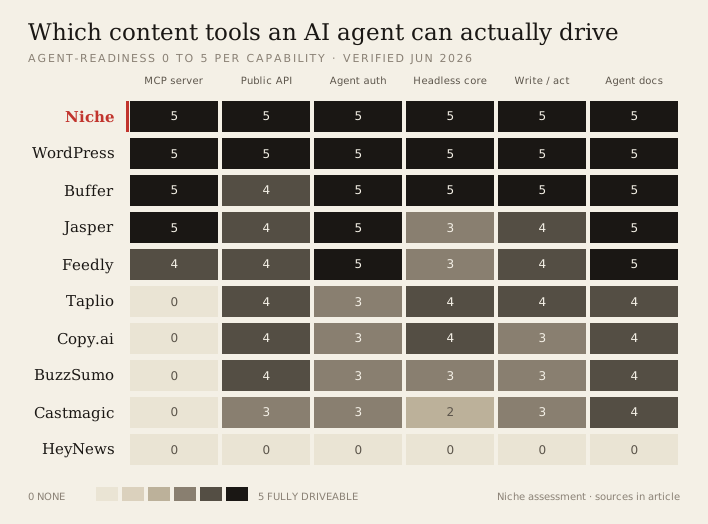
An agent needs six things to run a tool on your behalf, and we graded each from 0 (absent) to 5 (fully there):
- MCP server, does the vendor publish a Model Context Protocol server an agent connects to directly? This is the cleanest agent interface, and in 2026 it is the clearest signal a tool was built for agents, not just for scripts.
- Public API, is there a documented REST or GraphQL API, and does it read and write, or only read?
- Agent auth, can the agent authenticate without a human clicking consent on every call (API keys, OAuth, dynamic client registration)?
- Headless core, can the tool's actual core job run end to end with no GUI, or only its settings?
- Write / act, can the agent create or publish through the surface, or just read data back?
- Agent docs, is there documentation aimed at programmatic and agent use?
Every score below traces to a vendor source, linked in the tool notes. Here is the whole field on one grid.
The composite, and the honest surprise
Sum the six capabilities into a readiness score out of 30 and the result is not the marketing story you would expect.
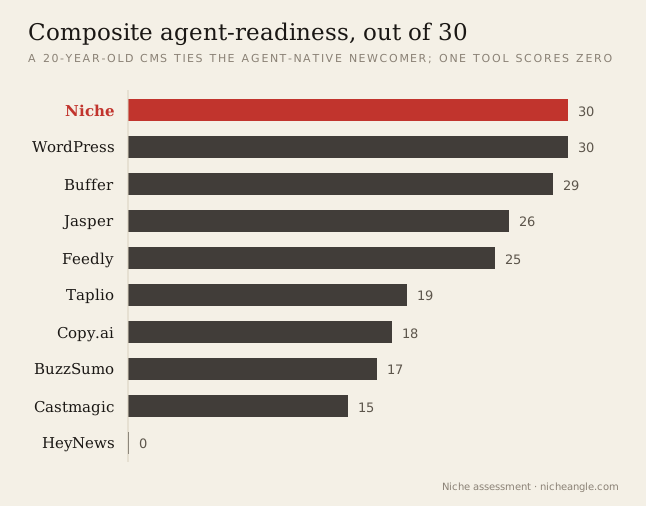
Two findings worth sitting with. First, a twenty-year-old CMS ties the agent-native newcomer: WordPress scores a clean six on every capability, because an agent can authenticate with built-in application passwords, create and publish a post over the core REST API, and as of 2026 there is even an official WordPress MCP adapter. Second, the most agent-ready tools are not all the AI ones. Buffer ships a first-party MCP server with a write-capable API. Jasper publishes one too. Meanwhile HeyNews, a 2026 AI newsletter product, scores a zero: no public API, no MCP, GUI only, with a deliberate human-review gate. "AI-branded" and "agent-driveable" turn out to be unrelated.
So the readiness score is necessary but not the whole story. It tells you an agent can drive the tool. It does not tell you how much of your job that covers.
Having an API is not the same as being agent-driveable across the job
The capability that the readiness score hides is scope: how much of the actual editorial job an agent can carry once it is in. Plot readiness against scope and the field separates cleanly.
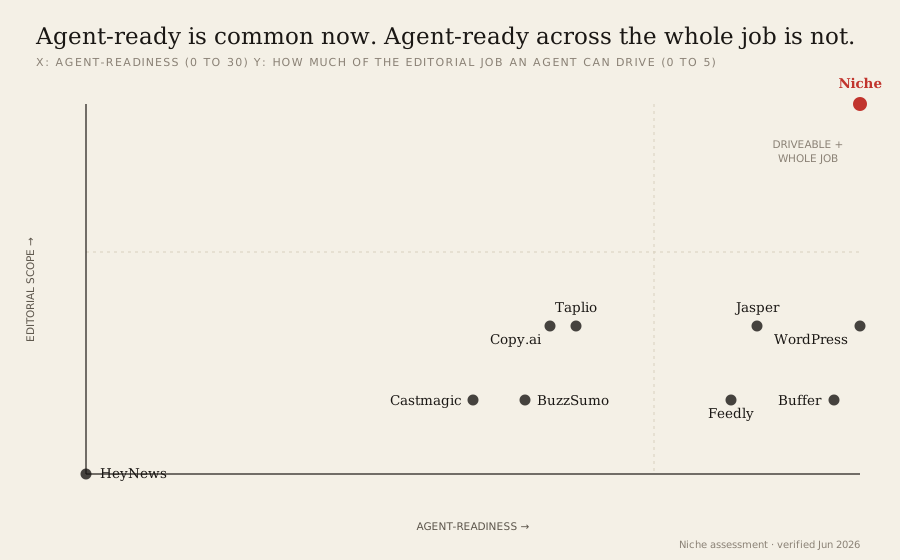
Almost every agent-ready tool is agent-ready for one slice. Buffer's MCP can publish and schedule, brilliantly, but it cannot decide what to post; it distributes what you already made. Jasper's MCP can draft content with your brand voice, but it does not publish, and its brand-context layer is read-only. WordPress can host and publish anything an agent sends it, but it has no opinion about what is worth writing. Feedly's MCP is genuinely capable but scoped to its threat-intelligence graph, and its general API is gated to Teams plans. Each is a strong agent surface over a narrow stage. The top-right of that chart, high readiness and the whole editorial job, is nearly empty.
The field, by how agent-driveable it really is
| Tool | Agent surface | What an agent can do today | The honest limit |
|---|---|---|---|
| Niche | 25-tool MCP + OAuth 2.1/DCR + PAT | Run the whole pipeline: find the story, frame the angle, draft, render, publish | Agent-shaped surface, not a broad public REST API for arbitrary apps |
| WordPress | Official MCP adapter + core REST API | Authenticate and create/publish posts end to end | Hosts and publishes; it has no discovery or editorial judgment |
| Buffer | First-party MCP + GraphQL API | Draft, schedule, and publish across every channel, headless | Distribution only; it cannot decide what to post |
| Jasper | Official MCP (mcp.jasper.ai) + write API | Generate brand-voice content programmatically | No publishing; brand-context layer is read-only; Business plan gated |
| Feedly | Official MCP (CTI-scoped) + OAuth API | Read, annotate, and board articles via API | General API gated to Teams; MCP scoped to threat intelligence |
| Taplio | REST API, API-key auth | Create drafts and schedule LinkedIn posts | No MCP; single platform; some endpoints unverified beyond indexed docs |
| Copy.ai | Workflows API, key auth | Trigger and retrieve workflow runs headless | No MCP; the API runs your workflow, it does not itself author |
| BuzzSumo | REST API, key auth | Run content research; create alerts and projects | No MCP; read-centric surface |
| Castmagic | Gated Bearer API + webhooks | Submit and retrieve transcriptions | No MCP; the AI repurposing core is marked "in development" on the API |
| HeyNews | None | Nothing programmatically | No API, no MCP, no docs; GUI only with a mandatory human-review gate |
A note on honesty: agent surfaces are moving fast, so treat this as a verified snapshot, not a permanent verdict. Each link points at the vendor's own docs so you can check the live state. Two cells came from indexed documentation rather than a first-hand render (Taplio's exact publish endpoints, HeyNews's in-app surface), and we have flagged them; HeyNews's human-review gate is a deliberate design choice, not a bug, even though it scores zero on agent-driveability.
Where Niche fits: tied on readiness, alone on scope
Niche is the editorial-intelligence tool in this set, and on the raw readiness score it ties WordPress at the top, not because it is the only tool with an agent surface, but because it ships all six capabilities: a 25-tool MCP server, OAuth 2.1 with dynamic client registration plus personal access tokens, a headless pipeline, write-and-publish tools, and agent-facing docs.
The place it is genuinely alone is the other axis. An agent pointed at Niche does not drive one slice; it runs the whole editorial job: it reads multi-source primary signal, picks the story, proposes the angle, drafts the platform-native post, renders the image card or reel, and publishes, with the same approval checkpoints whether you drive it from the chat desk or an agent drives it from Claude Desktop, Claude Code, or Cursor. That is the agent-native shape: the tool is the same engine whether a human or an agent is at the controls.
The honest framing is the one the data supports. If your agent's job is "publish what I made," Buffer or WordPress will do it beautifully and cost less. If its job is "draft in my voice," Jasper's MCP is strong. If its job is "decide what is worth writing, frame it, make it, and ship it, without me in the loop for every step," that is the empty corner of the chart, and right now Niche is the tool sitting in it. It is metered by credits, not seats, with a three-day, 2,000-credit trial that needs no card and free failed runs, so an agent that tries something and misses costs nothing.
Frequently asked questions
Which content tools have an MCP server in 2026?
As of mid-2026, several do: Niche (a 25-tool editorial pipeline), Buffer (publishing), Jasper (drafting), Feedly (scoped to its threat-intelligence graph), and WordPress (an official MCP adapter over its REST API). Many popular tools still do not, including Copy.ai, Taplio, BuzzSumo, Castmagic, and HeyNews. Agent surfaces are changing quickly, so verify against each vendor's current docs.
Can an AI agent fully run a content tool without a human?
It depends on the tool's surface. An agent needs programmatic auth, a write-capable API or MCP server, and a headless core. Tools like Niche, Buffer, and WordPress meet that bar for their job; tools with no public API, like HeyNews, cannot be agent-driven at all. Having an API is not enough on its own; read-only or settings-only APIs do not let an agent do the actual work.
Is an older tool like WordPress really as agent-ready as a new AI tool?
On raw capability, yes. WordPress has built-in application-password auth, a documented read/write REST API, true headless publishing, and now an official MCP adapter, so it scores a clean six. The difference is scope: WordPress hosts and publishes, but it has no discovery or editorial judgment. Agent-readiness and job coverage are two different axes.
What makes a content tool "agent-native" rather than just "API-accessible"?
API-accessible means an agent can call it. Agent-native means the tool's whole workflow is built to be driven by an agent end to end, with the same checkpoints a human would get, usually exposed through an MCP server rather than a thin REST endpoint. A read-only API or a single-action endpoint is accessible but not agent-native.
Related
- Best content tools for solo creators in 2026, the scored field guide this tracker pairs with (lifecycle coverage, the other axis)
- What is MCP for content?, how the Model Context Protocol lets an agent drive a content tool
- What is an agent-native content tool?, the difference between API-accessible and agent-native
- What is editorial intelligence?, the stage most agent-ready tools skip