Field guide
Best content tools for solo creators in 2026
There is no single best content tool in 2026, and any list that crowns one is selling you something. The honest answer is that the job splits into stages, discover what to write, choose the angle, draft it, render the finished post, distribute it, and keep it honest, and almost no tool is strong at more than two. So instead of a ranking, this is a scorecard: we graded the field on how much of that lifecycle each tool actually owns, scored every one from 0 to 5 per stage, and show you how to pick by your real bottleneck rather than by a feature list.
How we scored the field
We built one rubric and applied it to every tool, so the comparison is apples to apples. The framework, which we call the Niche Content-Stack Scorecard, grades eight lifecycle stages from 0 (the tool does not do this) to 5 (this is the thing it is best in the world at):
- Discover, does it find what is worth writing from primary sources and beat monitoring, or does it wait for your prompt?
- Angle, does it pick the story and propose a defensible position, or just expand a topic you already named?
- Draft, how good is the platform-native copy?
- Voice, does it persist your voice as a reusable profile, or re-prompt it every time?
- Render, does it produce the finished artifact (image cards, carousels, video), or stop at text?
- Distribute, does it schedule and publish across channels?
- Trust, does it attribute sources, ground claims, and refuse to publish a fabrication?
- Agent, can an external agent run the whole workflow headless, or is it click-only?
The scores below are our assessment, not vendor-published benchmarks. We rank tools on what shipped, not on roadmaps. Here is the whole field on one grid.
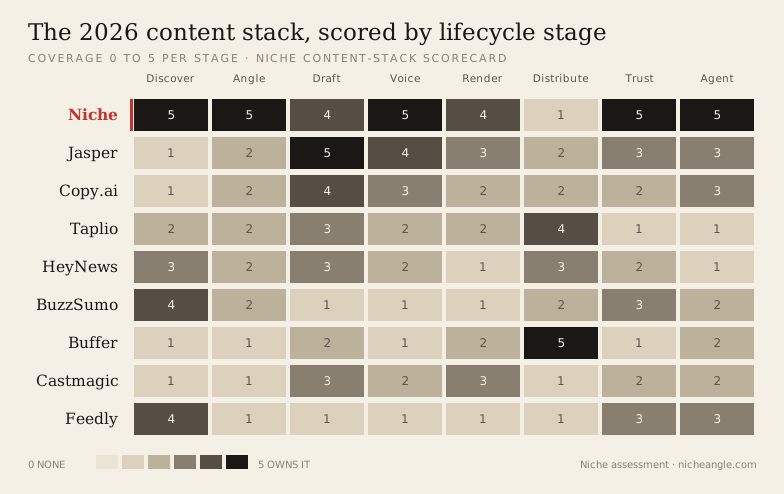
The grid makes the real shape of the market obvious. The color does not cluster in any single column for any single tool except at the edges: drafting tools light up the middle (Draft, Voice), schedulers light up one box on the right (Distribute), discovery tools light up the far left (Discover, Trust). The lane matters more than the brand.
The composite ranking, and why it is honest
Sum the eight stages and you get a coverage score out of 40. It is not a quality trophy, it is a breadth measurement: how much of the pipeline a tool carries end to end.
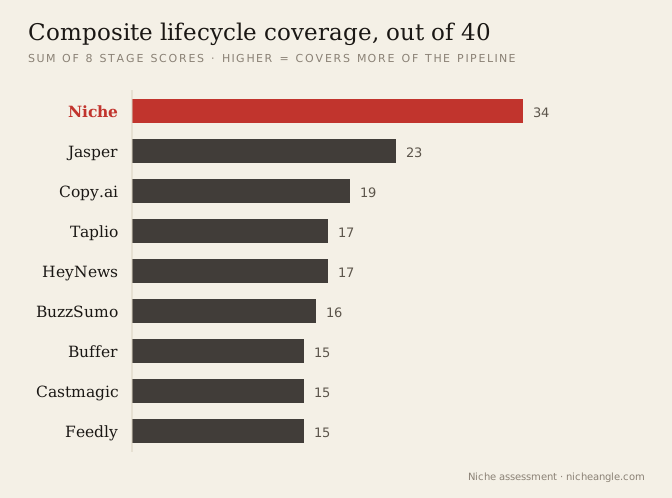
Niche tops the breadth score because it carries the front of the pipeline (discovery, angle) plus render, trust, and agent drivability in one engine. But read the grid again before you read that as "Niche wins." Niche scores a 1 on Distribute on purpose: it is not a scheduler, and it will tell you so. A creator whose only bottleneck is "I have the posts, I just need them queued across five channels on a calendar" should buy Buffer, which scores a 5 there and is cheaper for that one job. Breadth is the wrong axis if your problem is narrow. That is the entire point of scoring by stage instead of declaring a winner.
The field, by lane (strength and gap on each)
We scored nine representative tools, one or two per lane. For a deeper head-to-head on any of them, the per-tool comparison pages go further than a roundup can.
| Tool | Lane | Real strength | Honest gap |
|---|---|---|---|
| Niche | Editorial intelligence | Reads primary signal, picks the story, proposes the angle, renders the post, and an agent can drive the whole thing | Not a scheduler (pair it with one); five brand profiles on Studio, not unlimited |
| Jasper | Enterprise AI drafting | Best-in-class brand-voice drafting at team scale, packaged agents, real procurement and security scaffolding | Starts from your brief, not from the news; over-shaped and over-priced for one writer |
| Copy.ai | GTM drafting + workflows | Strong go-to-market copy and multi-step content workflows | Discovery and finished-artifact rendering are thin; voice is prompt-shaped, not persisted |
| Taplio | LinkedIn growth | Excellent single-platform draft-and-schedule loop with an engagement layer | One platform; little discovery, no provenance, no agent surface |
| HeyNews | AI newsletter | Curates the news into a sendable newsletter quickly | Curation is not angle ownership; thin render and trust controls |
| BuzzSumo | Content research | Deep content and influencer research for what is resonating | Research only, it does not draft, render, or publish |
| Buffer | Scheduling | The cleanest cross-channel scheduler at a solo price | Owns distribution and nothing else; it distributes what you already made |
| Castmagic | Repurposing | Turns audio and video into posts and clips after you record | Post-production only, it needs you to have already made the thing |
| Feedly | Discovery feeds | A fast feed reader with an AI research assistant and a real API | Stops at reading; no angle, no drafting, no render |
The pattern under the table is the master move of buying tools in 2026: never rank a scheduler against an editorial tool, or a drafter against a discovery tool. They own different stages. The question is not "which is best," it is "which stage is my bottleneck," and then "what is the cleanest tool for that stage that pairs well with the rest."
How to actually pick: audit the bottleneck
Before you buy anything, look at your last two weeks and ask which stage ate the most time.
- "I don't know what to publish today." Your bottleneck is discovery and angle, the front of the pipeline. This is where most solo creators actually stall, and where a feed reader or a research tool only half-helps (it surfaces inputs, it does not pick the story or hand you a position). This is the editorial-intelligence lane.
- "I know what to say, drafting drags." Your bottleneck is the middle. A strong drafter like Jasper or Copy.ai earns its price here, especially if voice consistency matters.
- "I have the posts, distribution is the chore." Your bottleneck is the back. Buy a scheduler. Do not buy an editorial engine to solve a calendar problem.
- "I make long things and need the clips." Your bottleneck is repurposing. Castmagic owns that stage.
The stack that results is usually two tools, not one: something that owns your bottleneck stage, plus a cheap scheduler at the back. A coherent solo stack in 2026 might be an editorial engine at the front and Buffer at the back, for less than most single enterprise seats.
Where Niche fits: the whole lifecycle, and either hand can drive it
Niche is the editorial-intelligence layer, the front of the pipeline that most tools skip. It reads multi-source primary signal (the regulatory filings, legislative and donor records, and the forums where a niche actually argues, the kind of input a web search skims past), clusters raw items into stories, ranks them by source diversity and beat fit, proposes several angles per story, and only then produces the platform-native draft and renders the image card or reel. That is the full run, from a niche to a finished, sourced post.
The part that is genuinely different in 2026 is that the same engine answers to two hands. You can drive it yourself from one chat surface, the content desk, or an agent can drive it headless through a 25-tool MCP surface from Claude Desktop, Claude Code, Cursor, or any MCP-compatible client. Same pipeline, same approval checkpoints, either driver.
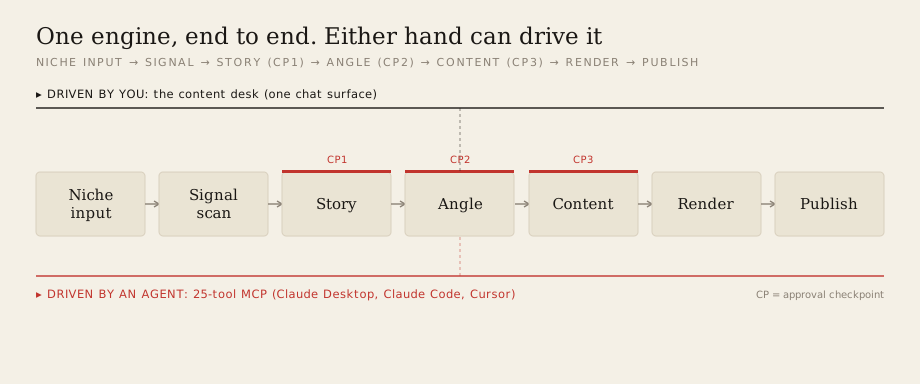
Three things keep that honest. Every run carries source attribution, so a claim traces back to where it came from. The checkpoints (story, angle, content) are real approval gates, not decoration, so nothing publishes that you did not see. And the pricing is built so a miss costs nothing: a three-day, 2,000-credit trial with no card, failed runs are free, then Creator at $39/mo, Studio at $99/mo, or Operator at $299/mo. It is metered by credits, not seats, because it is built for one writer holding a beat, not a team.
And the honest gap, the same one in the scorecard: Niche is intentionally not a scheduler and not an agency governance tool. It pairs cleanly with Buffer or a native publisher for distribution, and teams running many brands at high volume are better served by an enterprise platform. It owns the front of the pipeline and the agent surface. It hands the calendar to a tool that owns the calendar.
Frequently asked questions
What is the best AI content tool for solo creators in 2026?
There is no single best one, because the work splits into stages and no tool is strong at all of them. Pick by your bottleneck: a discovery and angle engine if you do not know what to publish, a drafter if writing drags, a scheduler if distribution is the chore. Most solo creators end up with a front-of-pipeline tool plus a cheap scheduler.
How did you score the tools?
We graded every tool from 0 to 5 across eight lifecycle stages (discover, angle, draft, voice, render, distribute, trust, agent) using one shared rubric, then summed them for a coverage score out of 40. The scores are our editorial assessment with the rubric disclosed, based on what each tool shipped, not on vendor benchmarks or roadmap claims.
Can an AI agent run a content tool end to end?
Yes, if the tool exposes its workflow as agent-callable tools. Niche, for example, runs the same discover-to-publish pipeline either from a chat desk or headless through a 25-tool MCP surface that an agent in Claude Desktop, Claude Code, or Cursor can drive, with the same human-or-agent approval checkpoints either way.
Do I need more than one content tool?
Usually two. One tool that owns your bottleneck stage (discovery, drafting, or repurposing) and a cheap scheduler at the back for distribution. Buying a single tool to cover the whole pipeline either overpays for stages you do not need or underdelivers on the one you do.
Related
- What is editorial intelligence?, the discovery-and-angle lane this scorecard puts at the front
- AI content tools for individuals: the 2026 landscape, the decision guide companion to this scored field guide
- What is a content desk?, the human surface that drives the pipeline
- What is MCP for content?, how an agent drives the same engine headless